Available Post 16 & Higher Sessions
Sessions work best with up to 30 students. For very large groups, please contact us to discuss how we can best accomodate you.
Click on an education session for more detail including curriculum links.
For Animal Care Students, we offer specific education modules which cover zoo animal care in more depth.
Detailed Session Descriptions:
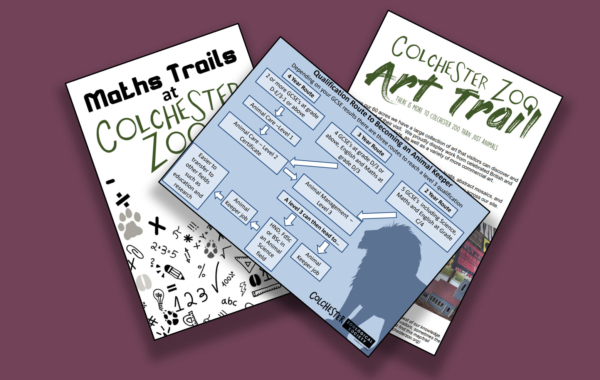
Art at the Zoo
Please note this session is for a maximum of 30 students.
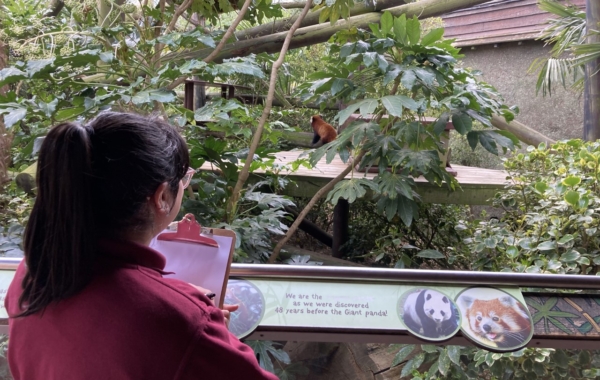
This session opens with a brief introduction to Colchester Zoo and how we use art. Then students have the opportunity to sketch, draw, or photograph from a variety of still life resources, including: furs, skins, skulls, feathers, and more. These resources allow students to get up close and pay attention to textures, patterns, shape, and structure. Students attending this session must bring their own dry drawing materials, sketchbooks, cameras, etc. Art materials will not be provided.
Click for curriculum topics covered
Art and Design:
- Increase proficiency in the handling of different materials
- Use a variety of approaches, including biomimicry, to generate creative ideas
- Record ideas and designs from a range of objects and artefacts
- Experiment with recording textures, patterns, shapes and structure
Classification Session
Please note this session is for a maximum of 40 students.After discovering why and how we classify things, students learn the different levels of the classification system (domain, kingdom, phylum, class, order, family, genus, and species). Students will get a chance to get hands-on with a variety of animal biofacts (furs, skulls, etc.) and practice sorting these objects into groups. The session then takes a closer look at class mammalia, through to humans at a species level. At the species level, students learn about what makes a species a species.
Click for curriculum topics covered
Biology:
- Demonstrate an understanding of the classification system of: domain,kingdom, phylum, class, order, family, genus, species.
- Describe the main characteristics of the main vertebrate groups: fish, reptiles, amphibians, birds, mammals
- Explain what defines a species and how this differs from subspecies
- Learn what a hybrid is
Conservation Talk
What is conservation and why should we care about it? Students discover this while examining endangered species artefacts and learning about the threats they face. After learning about how zoos and other organisations help conservation, students figure out why that might not be enough. The problems of uneven distribution of wealth and food are discussed leading into the issue of different stakeholder demands. The example of palm oil plantations in the rainforest is used to illustrate that different stakeholders have different priorities, which is then tied back into conservation.
This talk focuses on the big picture problems facing conservation. If you would like to focus on what zoos are doing to help, book the Zoos and Conservation Talk. If you would like to focus specifically on traditional medicine, book the Cures OR Conservation Session.
Click for curriculum topics covered
Biology or Environmental Coursework:
- Understand how humans interact to influence and change landscapes and environments
- Appreciate the complexity of conservation issues and how the needs of many different stakeholders must be considered
- Analyse the positive and negative effects of managing food production and distribution
- Recognise that practical solutions for human needs may require compromise between competing priorities
- Understand that deforestation leads to reductions in biodiversity and that a major cause of deforestation is food production
- Understand solutions to allow sustainable harvesting of natural resources such as timber and fish
- Appreciate the tension between conserving nature and the needs of local human communities
Citizenship coursework:
- Understand the issues of global interdependence and how they might be tackled
- Recognise policies and practices for sustainable development and their impact on the environment
Cures OR Conservation Session
The Future and History of Animals in Traditional Medicine
Many human cultures around the world and throughout history have used and continue to use animals, and parts of animals, as medicine. In this session students will learn about some amazing, scientifically proven medicines that have been based on chemicals and compounds found in a variety of animals. We then discuss the conservation issues associated with this, explained through the problem of bear bile farms.
We will then take a look how animals have been used throughout the history of European Medicine. The use of animals in modern Traditional Medicine is then linked back to endangered species with this concept explored in more detail with the explanation of how rhino horn is not medicine. Students will then get the chance to see real animal artifacts up close and learn how they have traditionally been used as medical treatment. We will then discuss the step by step process that scientists and researchers use when they attempt to find out if something is medicine and how they would go about creating new drugs. The session ends with a look at medicines of the future, and what the future could hold for Traditional Medicine with reference to the World Health Organisation.
Click to view curriculum topics covered
Biology coursework:
- Appreciate the complexity of conservation issues and how the needs of many different stakeholders must be considered
- Understand the potential resources of the natural world in the search for new medicinal cures
- Recognise that uncontrolled exploitation of natural resources will lead to destruction and potential extinction
- Understand that finding and developing new medicines is a very long and complex process – including pre-clinical and clinical testing
- Appreciate the tension between conserving nature and respecting traditional beliefs
History coursework:
- Learn how animals have been used as medicine throughout all of European Medicinal history
- Understand that European Medicine has changed through history
Q & A Session
Please note this session is 45 minutes, and for a maximum of 50 students.
This session is a bookable timeslot for your students to ask Colchester Zoo staff questions. Zoo staff are prepared to answer questions on a wide range of topics including how we use science at Colchester Zoo, how we meet the needs of our customers, health and safety concerns of a zoo, case study examples of our conservation projects around the world, or a focus on any other topic.
This session is ideal for students who are required to gather specific information for completing mock assessment, portfolios, workbooks, etc.
Students attending this session MUST come prepared with a list of questions to ask the speaker.
Teachers in Training
All About School Trips
Trainee teachers will learn all about planning an educational school trip, using Colchester Zoo as a point of reference. We cover the rationale for school trips, and how this can be used to increase student learning. We’ll then walk through the steps to plan a successful trip. This includes information about risk assessments, organising adult helpers, planning activities, and how to link trips to the national curriculum. The session includes a chance to look at the education department’s teaching resources (skulls, furs, etc.), as well as examples of some of the formal education sessions teachers can book.
There are two different versions of this sessions, one designed for future EYFS and Primary teachers and one designed for future Secondary teachers.
Click to view curriculum topics covered
Planning for school trips:
- Understand the importance of risk assessments
- Gain familiarity with Health and Safety regulations related to school trips
- Learn how to develop useful worksheets and trip activities
- Be able to justify the educational potential of school trips
- Understand how to better utilise adult helpers
- Learn how to make the most out of your school trip
Zoos & Conservation
The Role of Zoos in the 21st Century
What do zoos do, and why? Students learn the main goals of a modern zoo. Based on these goals, students can consider their own opinions about zoos while discovering how zoos play vital roles in conservation. Colchester Zoo’s contributions to in-situ and ex-situ conservation will be discussed using specific case studies.
This talk focuses on what role zoos play in the modern world, with a large focus on conservation action zoos are taking. If you would like to focus on the big picture problems causing conservation issues, please book the Conservation Session.
Click to view curriculum topics covered
Biology coursework:
- Appreciate the complexity of conservation issues and how the needs of many different stakeholders must be considered
- Understand reasons for loss of global biodiversity
- Recognise that uncontrolled exploitation of natural resources will lead to destruction and potential extinction
- Understand the roles played by NGO’s, including zoos
- Understand the differences between Ex-situ and In-Situ conservation
- Link the importance of genetic management to long term captive populations
- Understand how all conservation organisations work together towards The One Plan approach towards conservation
Citizenship coursework:
- Consider the ethical implications of keeping animals in zoos
- Think critical and consider pros and cons of a complex issue
Zoo Visitor Psychology
Real world case studies of psychology in context
45 min session – focusing on Social & Environmental Psy OR Cognitive & Conservation Psy
90 min session -combined version covering all four topics.
Students will discover how psychology concepts are applied in practice at Colchester Zoo to help us meet our mission statement goals. These goals are: ‘Be a Great Visitor Attraction’ explored through Social and Environmental Psychology, ‘Help Visitors Learn About Animals’ explored through Cognitive Psychology, and ‘Help Endangered Animals’ explored through Conservation Psychology.
Various peer-reviewed, published studies are used as the basis for concepts and ideas explored throughout the session. The session also includes specific real-world examples from Colchester Zoo, and studies we have conducted on site.
Click for curriculum topics covered
Social & Environmental Psychology:
- Main factors that drive social behaviour
- Primary vs. secondary data – what are they and what benefits do they have
- Qualitative vs quantitative data
- Bias, in reference to visitor surveys
- Maslow’s Hierarchy of needs including deficiency and growth needs (8 Level version)
- Methods of measuring emotion (SAM and physiological measures)
- Experimental methods (lab, field, and natural)
Cognitive & Conservation Psychology:
- Learning theories
- Multiple Intelligence theory (including criticism and counter arguments)
- Classical and operant conditioning
- Environmental behavioural change
- Tri-component model of attitude
- Theory of planned behaviour